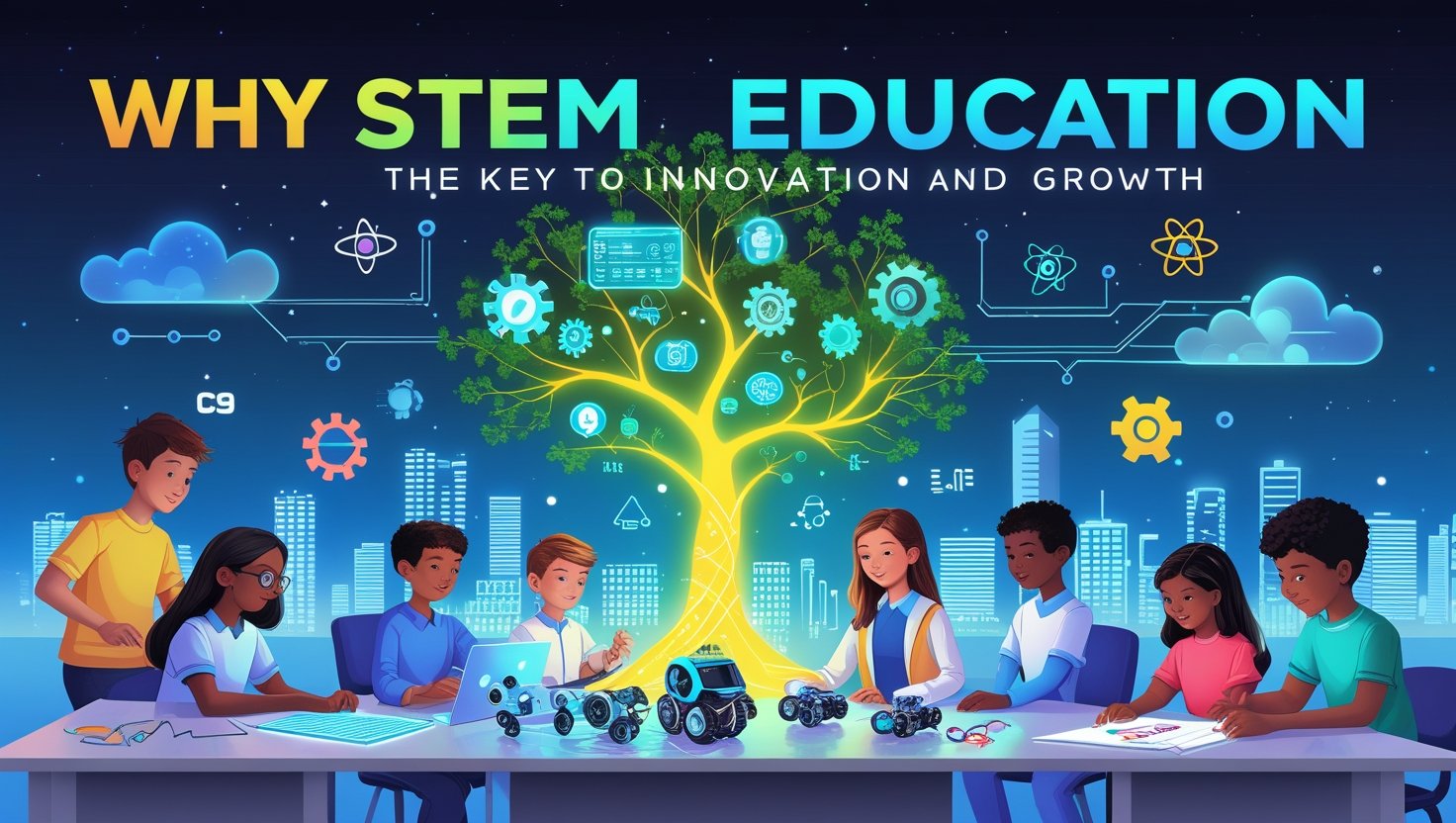
Why STEM Education Is the Key to Innovation and Growth:
In today’s era, when technology is rapidly progressing, the importance of STEM education has increased even more. STEM means Science, Technology, Engineering, and Mathematics. These four fields together form an educational foundation that not only prepares students for modern challenges but also shows them the path of innovation and creativity. Today, every field that is moving towards growth and progress, be it healthcare, artificial intelligence, renewable energy, or space exploration, has the brain of STEM brain behind it all.
The focus of STEM education is not limited to just theoretical knowledge, rather, it teaches students how to understand and handle real-life situations through problem-solving, logical thinking, and hands-on learning. When a student grows on a STEM base, his/her approach becomes analytical, which is a valuable skill in today’s dynamic world. This education system makes students critical thinkers who not only have knowledge but also the courage to apply it.
In this blog, we will explore how STEM education boosts innovation, grows the economy, and it makes today’s students the leaders of tomorrow. STEM is not just a subject group but the key to the future, which can make every society smarter, stronger, and more advanced.
How STEM Drives Innovation Across Industries:
STEM education forms the foundation of new ideas and inventions in every industry. When people take steps in the practical world with the knowledge of science, technology, engineering, and mathematics, they bring new methods to every field. For example, in the healthcare industry, new medical devices are being made due to STEM, early diagnosis of diseases is happening with the help of AI, and surgeries have become more precise. Similarly, in agriculture, too, both the quality and quantity of decisions are improving due to drones, sensors, and data analysis.
Engineering and technology sectors are also running on STEM. Self-driving cars, smart homes, renewable energy systems and even space missions like Mars exploration have been made possible because of STEM. When students get STEM education, they develop critical thinking and problem-solving skills that are a basic part of innovation. These skills inspire them to find new solutions to societal problems and develop tools or systems that make people’s lives easier.
STEM professionals are in demand in industries where research and development play a role. They not only design new products but also make old systems efficient and environment-friendly. All this shows that STEM education is the main source of innovation and without it no field can move forward in the future.
Building a Future-Ready Workforce with STEM Skills:
Today’s job market is changing rapidly and the demand for new skills is increasing every day. STEM education equips students with the skills needed for the future. When a student learns STEM subjects, he or she not only learns formulas and theories but also learns logical thinking, data analysis, and using digital tools. These skills prepare them for future jobs where technology and automation are far ahead.
STEM education makes students flexible and adaptable. They are able to analyse each problem and find innovative solutions. For example, jobs in fields such as software development, cybersecurity, robotics, data science are growing rapidly today and a STEM background is essential for all of these. This means that if a student gets a STEM education, he or she has more career options that provide good salary and stability.
It has also been observed that STEM graduates start their own business or startup more confidently as they have both creative thinking and technical knowledge. Today’s employers also want people who can use new tools and make better decisions through data. That is why STEM education plays a central role in providing every society with a strong, modern and skilled workforce.
STEM’s Impact on Economic Growth and National Development:
When STEM education is promoted in a country, not just individuals but the entire economy benefits from it. STEM starts new businesses, new products and services are developed, and new jobs are created. When people create new solutions and technologies, they make industries efficient and competitive, which helps the country’s economy grow. For example, tech companies like Google, Apple or Tesla have created economic impact not just in their countries but around the world, and all of this was possible through STEM.
A strong STEM foundation also boosts research and development (R&D). The more R&D there is, the faster new inventions and technologies will come to the market. This innovation becomes an export and earns foreign revenue. At the same time, government systems also improve through STEM, such as smart cities, digital governance, and clean energy solutions.
If developing countries invest in STEM education, they can come out of poverty and become self-reliant and modern economies. STEM professionals develop infrastructure, set up industries and prepare the base of a knowledge-based economy. Thus STEM education is not just a means of personal growth but is also the most important engine of national development.
Overcoming Challenges in STEM Education Access:
While the importance of STEM education is increasing, access to it is still difficult for many students. In many developing countries, schools lack resources, qualified teachers, and poor infrastructure for science labs and digital tools. All of these barriers hinder the provision of STEM education at a quality level. In addition, girls and students from underprivileged communities face extra challenges to advance in STEM, such as stereotypes, social pressure, and a lack of encouragement.
It is important to make STEM education inclusive. For this, governments, NGOs and the private sector will have to work together. STEM should be promoted in areas where people have less exposure through scholarships, awareness campaigns and school improvement programs. Online learning platforms are also a good option where students can learn coding, robotics and science experiments from free resources while sitting at home.
Teachers should also be provided with modern techniques and STEM training so that they can inspire students. When a student sees that he can create a solution to a real-world problem, his interest increases. In this way, we can make society more equal and future-ready by making STEM accessible to every student. Breaking barriers and creating opportunities is the true purpose of STEM.
Conclusion:
STEM education is a powerful investment for every society that can make the future smart, innovative and sustainable. As the world is becoming digital and technology-driven, the demand for STEM is increasing in every field. Be it business, healthcare, agriculture or space exploration, STEM professionals everywhere are developing new solutions with their expertise that are making life better and easier.
If we provide quality STEM education to today’s generation, they can become tomorrow’s entrepreneurs, engineers, doctors, scientists and problem solvers. These people will not only make their careers but will also boost the country’s economy. But this is only possible when we ensure inclusive and equitable STEM access where every boy and girl has equal opportunity to learn.
It is very important to have modern labs, trained teachers and updated curriculum in schools. At the same time, the role of parents and community is also important to motivate children to take interest in STEM subjects. When every part of society provides a platform for STEM, only then will we be able to move towards a smarter and stronger future. Ultimately, STEM education should not just be an academic choice but a national priority that opens new paths for every student and new opportunities for every country.
FAQs:
1. What is STEM education and why is it important today?
STEM stands for Science, Technology, Engineering, and Mathematics. It’s important because it prepares students with practical skills like problem-solving, critical thinking, and analytical reasoning. In today’s fast-paced technological world, STEM education equips learners to handle real-world challenges and drives innovation across all major industries.
2. How does STEM education contribute to innovation in different fields?
STEM knowledge helps create new solutions and technologies in fields like healthcare, agriculture, and transportation. For example, it enables early disease detection using AI, improves farming with drones and sensors, and supports innovations like smart homes and space missions. Students trained in STEM bring fresh ideas that solve everyday problems and improve lives.
3. In what way does STEM education prepare students for future jobs?
STEM education develops technical and soft skills needed in today’s job market such as data analysis, coding, and adaptability. Careers in areas like robotics, cybersecurity, software development, and data science rely heavily on STEM. It also encourages entrepreneurship by combining creativity with technical knowledge, helping students launch their own startups.
4. What is the role of STEM education in a country’s economic development?
STEM drives national progress by fostering innovation, creating high-tech businesses, generating employment, and enhancing productivity. It boosts research and development, brings in foreign investment, and helps governments implement smart solutions like digital services and clean energy projects. A strong STEM foundation transforms economies into knowledge-based, self-reliant systems.
5. What are the challenges in providing STEM education to all students?
Many students, especially in developing countries, face barriers like lack of qualified teachers, poor lab infrastructure, and limited access to technology. Girls and underprivileged students often experience extra hurdles due to stereotypes and limited support. Inclusive efforts like scholarships, digital learning tools, and teacher training are crucial to make STEM education accessible to everyone.